
Why Dental Marketing Is Different From Other Industries
I got on a call with a competent marketer who is a friend of a dentist. The recommendations made sense. They just do not make sense in dental.
I got on a call with a competent marketer who is a friend of a dentist. The recommendations made sense. They just do not make sense in dental.

I got on a call with a competent marketer who is a friend of a dentist.
He had all the recommendations ready to go. They made a lot of sense.
However, they do not make sense in dental.
Here is one of them.
His recommendation was to send all the traffic to a landing page.
That maybe works in other industries. That does not work in dentistry.
For a gym, a landing page can be great. You have an offer. They sign up. They are interested. If not, they leave. The job of the page is narrow.
With a dentist, someone comes to the page looking for a procedure. They also want to know about the dentist. Then they want to know about the location. Then they want to know about financing. Reviews. Hours. Whether you take new patients. Whether you do emergencies.
The decision is personal and multi-step. Trap that person on a single landing page with one button and nowhere to go, and you can waste a ton of money.
We frequently look at campaigns where dentists show us reports and their marketing company is spending a ton of money on terms that we know do not show up as actual patients.
For example, they will spend a third of their budget on hygiene terms like cleanings. They shy away from terms like dentist near me because it is expensive.
We look at the data. Those more expensive search terms actually show up as patients.
So you have a non-specific marketer optimizing for the lowest cost per conversion, but not necessarily for the quality of the appointment.
This is something you only get with a dental-specific marketing company.
What works for other marketing channels and other industries is not the same as what works for dentists.
That is why having a dental marketing specific company matters so much. You need a marketing partner that goes an inch wide and a mile deep on dental, not a mile wide and an inch deep across every vertical under the sun.
I speak to competent marketers all the time. They are good at marketing. Their experience is just outside of dental. So they bring recommendations that sound smart in a general playbook and fall apart in a dental practice. The landing-page recommendation is one example. There are others.
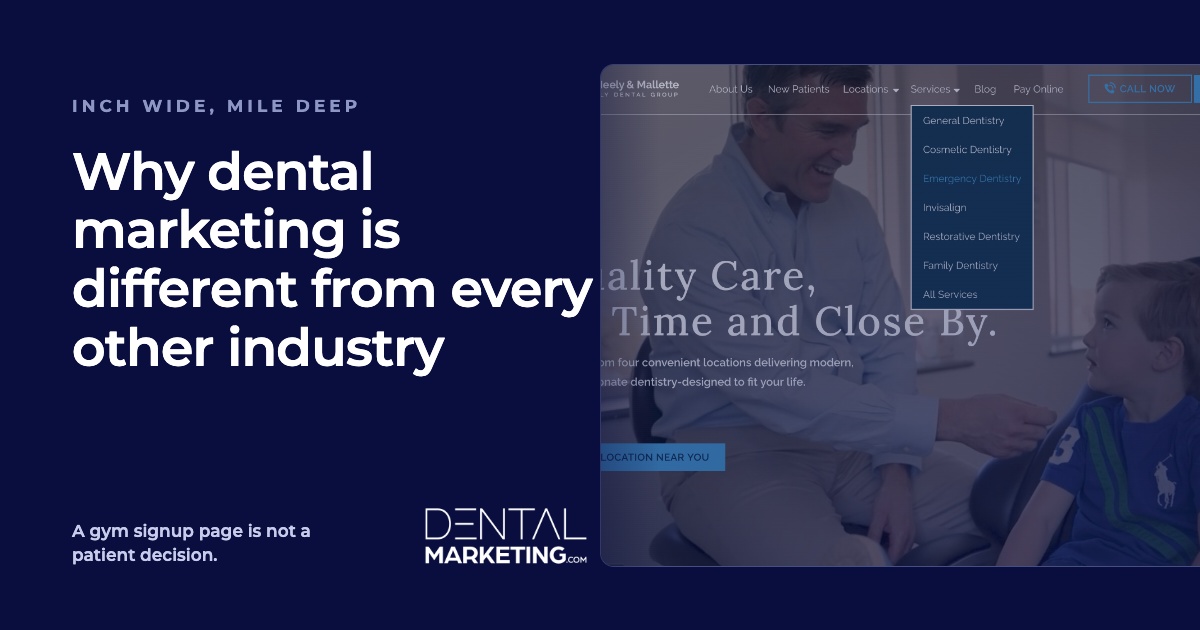
We send traffic to full websites that still feel like a landing page on the service pages: clear offer, clear next step, no fluff.
But the patient can also navigate the rest of the site. That is user flow. Doctor bio. Location. Financing. Other services. Trust pages.
Mapped over a three to six month period, that fuller experience ends in higher conversion rates than trapping every click on a dead-end landing page built for a different industry.
Dental has its own:
A generalist agency can copy tactics from e-commerce, SaaS, or fitness. A dental-specific team already knows which of those tactics survive contact with a real practice.
If your current plan was built for another industry and bolted onto dentistry, ask whether the funnel matches how dental patients actually decide.
Talk to DentalMarketing.com. We stay inch wide and a mile deep on dental marketing so the strategy fits the chair, not a gym signup page.


