
Google Maps Optimization for Dentists in 2026
Open your Google Business Profile right now. If service areas are blank or every big city is checked, you're making the mistake we see every week.
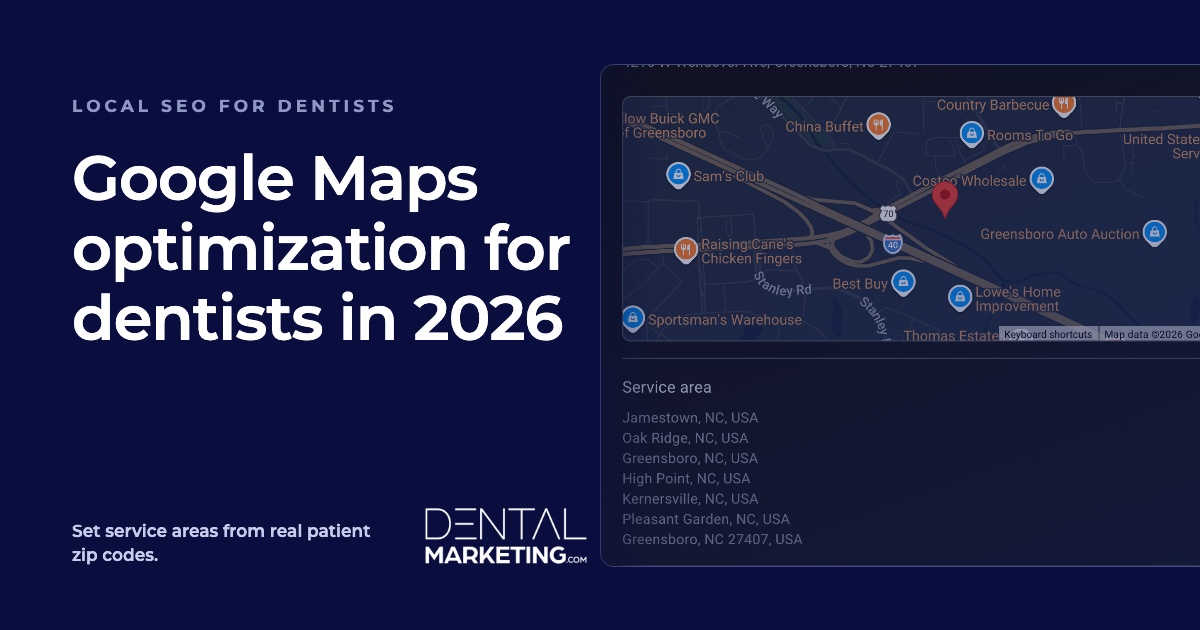
Open your Google Business Profile right now. If service areas are blank or every big city is checked, you're making the mistake we see every week.
.svg)
A doctor called us last month frustrated. Ads were running. The website looked fine. Direct mail was dropping. Still not enough new patients. “We're on Google,” he said. “I don't get it.”
So we pulled up his Google Business Profile (what a lot of practices still call Google My Business / GMB) next to a couple of competitors. Same city. Similar reviews. The difference wasn't some secret SEO trick. It was a boring settings mistake most dentists (and a lot of marketing companies) still make.
You might be making it too. Open yours while you read this.
That little section is error number one for a lot of practices.
If you don't have service areas selected, that's a huge mistake. Most dentists don't. Their listing is incomplete in a place Google actually uses for local relevance.
We'll walk through how to set it the right way later in this article. First, check whether it's blank. If it is, you're already behind practices that told Google where they actually want patients from.
If service areas is filled out, open it carefully. A lot of offices (or whoever set up GMB for them) checked every big city in the region.
That feels ambitious. It's usually a dilution problem.
You're basically telling Google: we want to show up everywhere. In huge population centers, that means you're volunteering to compete with every dental office in those metros. Your local SEO for dentists gets spread thin. Google doesn't know your real draw. Patients from far away aren't who fill your chairs anyway.
Better to target the right places on your GMB than to look “big” on a settings screen.
Here's what we like to do with practices we work with.
That tells Google something clear: this is where we pull patients from. Not every huge city on the map. Your real market.
That one change alone is one of the best Google Maps optimization moves you can make, because it stops diluting your marketing and lines Maps up with reality.
Keep that open. The rest of this guide is how we think about Maps in 2026 so those searches turn into new patient calls, not vanity rankings.
Patients don't wake up wanting “SEO.” They want a dentist who takes new patients, is open, looks trustworthy, and answers the phone.
Someone types dentist near me, dentist + your city, or emergency dentist. Google shows a map and three offices. They tap Call. They rarely scroll to page two.
That's why Google Maps optimization sits inside local search optimization and dentist SEO, right next to your website and your ads:
We run Google Ads, websites, and mailers for hundreds of practices. Same pattern over and over: you can spend on ads and still lose “dentist near me” to the office with cleaner GMB settings, fresher reviews, and a front desk that picks up. Maps doesn't replace ads or direct mail. It decides who gets the free, high-intent traffic first.
Our clients talk about results, a steady flow of new patients, and growing the practice. Maps is one of the first places that either supports that or quietly works against it.
Google still ranks local results on relevance, distance, and prominence. What changed is how answers show up on the map.
Ask Maps / AI answers. Patients ask natural questions inside Maps. Google pulls from your profile, reviews, photos, and website. If hours on the site don't match GMB, or services are empty, the AI guesses. That's bad for you.
Fresh beats “we set it up years ago.” Keyword stuffing in the business name gets you in trouble. New reviews lately matter more than a pile of old five-stars from 2019. Weekly posts and new photos signal you're open.
Your website FAQ feeds the map. “Do you take new patients?” and “Are you open Saturdays?” need clear answers on your site. That's AEO (answer engines) and Maps at the same time.
If your profile hasn't been touched since onboarding, you're already behind.
Once you've got your patient zip export:
Don't invent a 50-mile fantasy radius. Don't leave it blank. Match the map to the zip codes already paying you.
Then finish the rest of the profile so you're not winning service areas and losing on hours, categories, or reviews.
Match the sign and the website. No “Best Cosmetic Implant Dentist City Name” keyword stuffing.
NAP should match on the site, Google, and main directories. Tracking numbers are fine for ads and call analytics. Don't confuse Google with five public numbers.
Primary category for most general / family offices: Dentist.
Secondary categories only for what you actually do.
List services in patient language: new patient exam, emergency visit, implants, Invisalign, whitening, root canals.
Hours on Google must match the website, including lunch and Saturday.
Turn on true attributes: accepts new patients, parking, accessibility.
Make Call or Book obvious. Ranking without a path to schedule is how you “win Maps” and still don't grow.
Patients compare offices on their phone. Show the building, desk, team, chairs. Update photos.
Ask for reviews after good visits. Reply fast. Stay HIPAA-safe. Specific language (“same-day emergency,” “gentle with kids”) helps more than “great office!!”
Matching NAP, city language for where you draw patients, a simple FAQ, mobile Call / Book. One messy hour list on the site can undercut a clean GMB.
If the only KPI is “we're #1 in the pack,” you're measuring the wrong thing.
Watch:
We've seen practices “rank” and still lose because nobody answers, hours are wrong, service areas are diluted, or booking is broken. Google Maps optimization that doesn't hit the phone and the schedule isn't finished.
That's how local SEO for dentists turns into something owners feel: more of the right people calling.
Making your Google Business Profile (GMB), reviews, photos, hours, service areas, and website accurate so you show up in the Map Pack and on Maps, then turn those views into new patient calls and appointments.
Blank areas leave Google guessing. Selecting every huge city dilutes you into markets you can't win. Your real patient zip codes tell Google where you actually draw from.
It's a big piece, not the whole thing. You still need the website, citations, and real authority. Maps is usually the front door for high-intent searches.
Neglected profiles often move within a few months after a real cleanup. Tough metros take longer. Overnight #1 everywhere isn't a real plan.
For most growth-minded practices, yes. Organic Maps compounds. Ads cover competitive markets and emergency demand while SEO builds. We usually run them together.
Open your GMB service areas today. If they're blank or stuffed with every big city, fix that with your patient zip codes first.
If you want a straight read on your Maps presence versus the practices around you, talk to DentalMarketing.com. We'll show you what's broken and what to fix first.
.svg)


