Free Guide: Why Dental Practices Fail Local SEO and How to Fix It
A step-by-step guide to diagnosing weak local rankings and improving Google Business Profile, on-page SEO, and local citations to drive more high-intent patient leads — written from the trenches by the team at DentalMarketing.com.
28.5.2026
read in
15
minutes
Introduction: The Local Search Gap in Dentistry
Most dental practices invest in a website and assume the patients will come. They do not.
We know because we get on the phone with dentists every week who say a version of the same thing: "Our previous marketing company guaranteed phone calls. They never came." Or "We had dropped off of page 1 for most of our important search terms and didn't know why." Or our personal favorite, from a dentist whose schedule was empty four months after opening: "I'm spending money. I just can't tell what it's doing."
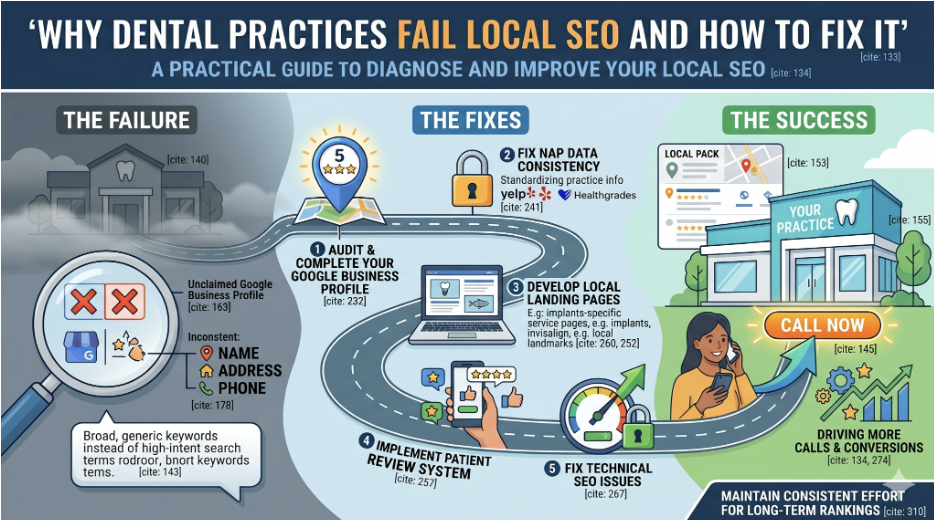
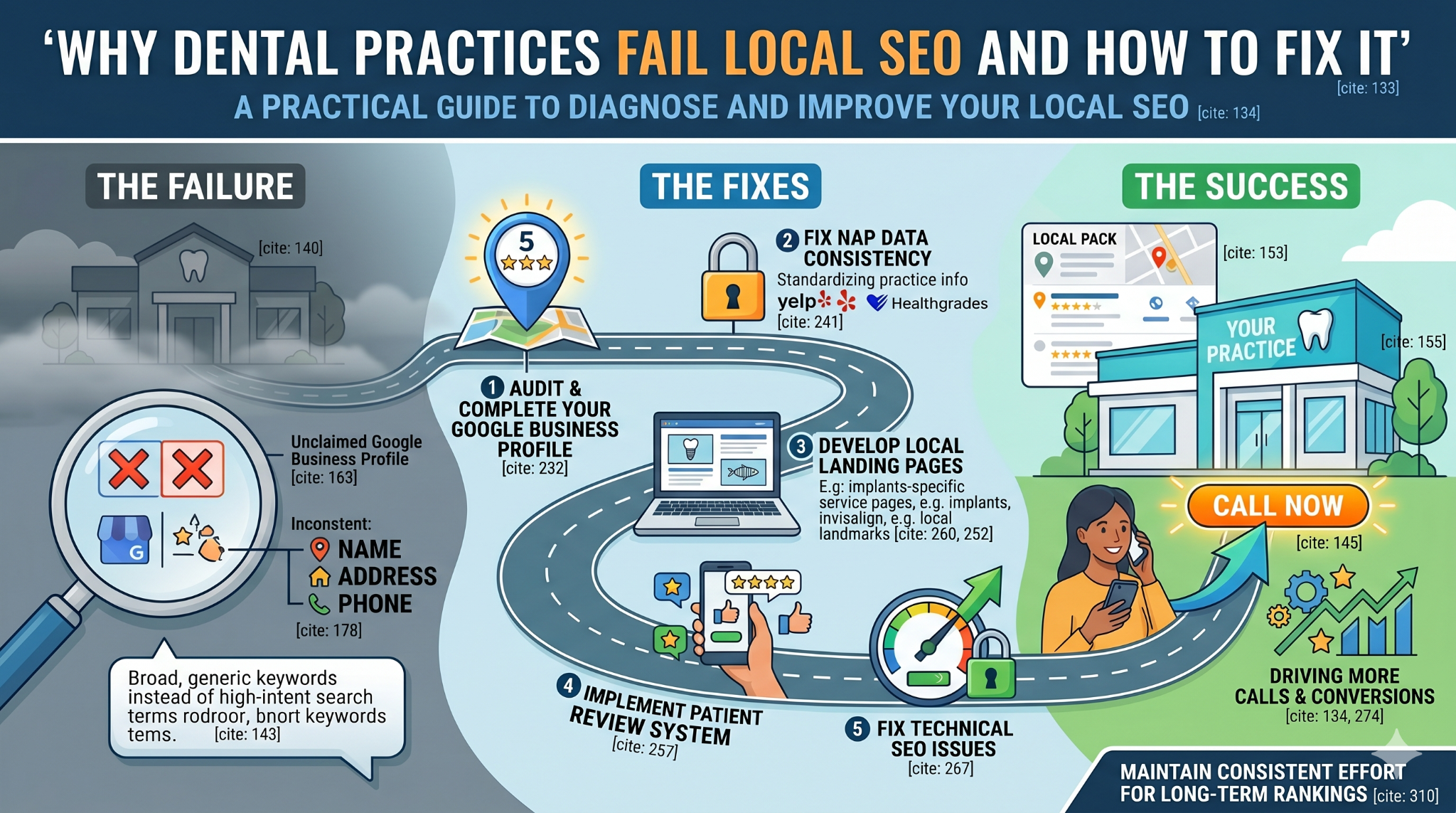
A professionally designed website with no local SEO strategy is essentially invisible to the patients searching for a dentist in your area right now. The harsh truth is that most dental practices underperform in local search not because the competition is unbeatable, but because a small set of fixable problems are quietly suppressing their rankings. An unclaimed or incomplete Google Business Profile. Citation inconsistencies that erode Google's confidence in your practice location. Web pages that target broad, generic keywords instead of the specific high-intent searches that actually book appointments. A web form that sends patient submissions to a personal Gmail. A "Call Now" button on Google that is firing the wrong tracking number.
This guide walks through the most common causes of weak dental local rankings and provides a practical, step-by-step roadmap for fixing each one. You do not need a six-figure marketing budget to implement these strategies. You need a clear diagnosis and a prioritized action plan — and the discipline to execute it month after month.
Part 1: Why Local Search Visibility Is the Most Valuable Real Estate in Dentistry
When someone searches for a dentist, they are not comparing national options. They are searching with location intent: "dentist near me," "emergency dentist [city]," "pediatric dentist [neighborhood]," "dental implants [ZIP]." These searches have extremely high commercial intent — the person typing them is usually ready to book an appointment within the hour.
Google responds to these searches with a Local Pack — the map-based result that appears at the top of the page showing three dental practices, their ratings, and their distance from the searcher. The majority of local search clicks go to one of those three results. If your practice is not in the Local Pack for your core service keywords, you are missing the highest-value acquisition channel available to you, and you are paying competitors for new patients you should be capturing.
Below the Local Pack are the organic search results, where more content-driven rankings appear. Capturing both the Local Pack and the organic results for the same keyword effectively doubles your real estate on the page and significantly increases the probability that the searching patient picks up the phone and calls you instead of someone else.
Key Stat
Approximately 46% of all Google searches have local intent. Approximately 94% of all web conversions for dental landing pages happen on mobile. Combine those two numbers and the takeaway is unavoidable: the patient is searching from a phone, with location intent, and they are about to choose someone. The question is whether they choose you.
Part 2: The 7 Most Common Reasons Dental Practices Fail Local SEO
1. Incomplete or unoptimized Google Business Profile
This is the most common problem we find when we audit a new account, and it is also the most fixable.
Your Google Business Profile (GBP) — formerly known as Google My Business or GMB — is the foundation of your local SEO. It directly controls whether and where you appear in Google Maps and the Local Pack. Yet the majority of dental practices have profiles that are incomplete, inconsistently updated, or simply unclaimed.
Common GBP problems we see:
Missing or incorrect business categories ("Dentist" alone is not enough — add "Cosmetic Dentist," "Dental Implants Periodontist," "Pediatric Dentist," "Emergency Dental Service" as applicable)
No service menu, or a service menu with three vague entries
A sparse photo library with no interior shots, no team, no equipment, no before-and-afters
No regular Google Posts activity, which signals to Google that nobody is home
Unanswered patient questions sitting in the Q&A section for months
Inconsistent hours, especially holiday hours, weekend availability, and extended evening slots
The newest layer here is AI agents that monitor your profile, respond to patient prompts in real time, and improve the responsiveness signals Google uses to rank you. We have been adding these for our clients and watching GMB call-ins climb practice-over-practice. If your GBP has not been touched in six months, you are not just standing still — you are quietly slipping behind every competitor whose profile is being managed.
2. Inconsistent NAP data across the web
NAP stands for Name, Address, and Phone number. When your practice information appears inconsistently across Yelp, Healthgrades, Zocdoc, Vitals, Bing Places, Apple Maps, and the dozens of smaller directories that scrape from each other, Google cannot confidently determine which information is accurate. That uncertainty directly suppresses your local rankings.
Common NAP problems we find:
Different phone numbers on different platforms — especially when a call tracking number was used on some platforms but not others (and yes, Google's own dynamic phone tracking can also provision numbers that look "wrong" to a practice that doesn't know what they are looking at)
Suite numbers missing from some listings, present on others
Old addresses from a previous location still appearing on directory sites years after the move
Slightly different business name variations: "Dr. Smith Dentistry" vs. "Smith Dental" vs. "Smith Family Dentistry, PLLC"
The fix usually starts with a one-time citation cleanup — we run a Bright Local report on the practice as part of onboarding, identify every directory that has the practice listed, and lock in a single canonical version of the name, address, and phone number across all of them. It is unglamorous work. It is also one of the highest-ROI hours you will ever spend on SEO.
3. No location-specific landing pages
A single "Services" page that lists every procedure you offer does not perform well for local searches. Google wants to see that your website contains content specifically relevant to the geographic area and the specific service the patient is searching for.
Practices without dedicated local landing pages miss searches like:
"dental implants [city name]"
"Invisalign provider [neighborhood]"
"all-on-X near [zip]"
"porcelain veneers [city]"
"emergency dentist [city]"
"sleep apnea dentist [neighborhood]"
Each major procedure you offer, multiplied by each geographic area you serve, represents a potential landing page opportunity. The competitor down the street may have already captured several of them while you are still running a single Services page from 2019.
4. Insufficient or stagnant review profile
Patient reviews are one of the top local ranking factors Google uses. More importantly, they are the primary trust signal that converts a searcher into a caller. A practice with 15 reviews from 2021 is at a significant disadvantage compared to a competitor generating 10 fresh reviews per month.
Most practices leave reviews entirely to chance. There is no systematic process for requesting reviews from satisfied patients, no monitoring of new reviews across platforms, and certainly no front-desk training on when and how to ask. This passive approach is a major missed opportunity, and it is one of the easiest gaps to close — once you treat reviews as a system rather than a hope.
5. Technical SEO problems on the practice website
Technical SEO problems are invisible to the human eye but have a significant impact on how Google evaluates and ranks your website. Common technical issues we surface in audits:
Slow page load times, especially on mobile — and remember, roughly 94% of dental web conversions happen on mobile
No SSL certificate (the dreaded http:// instead of https://)
Duplicate content across service pages because someone wrote one page and then copy-pasted it ten times
Missing or poorly written title tags and meta descriptions on every page
No LocalBusiness schema markup to help Google (and AI search engines) understand your practice details, hours, and accepted insurance
Broken internal links — including the embarrassingly common nav link that points to /# instead of an actual page
Crawl errors sitting in Google Search Console that nobody at the practice has logged into in years
Web forms collecting patient information that submit to a personal Gmail account (a HIPAA risk and a trust signal Google can detect indirectly through user behavior)
Missing accessibility basics like a "skip to content" link in the navigation, which is increasingly relevant under 2026 ADA enforcement
6. No local link building strategy
Links from other websites to your practice website signal authority and relevance to Google. For local SEO specifically, the geographic context of those links matters — a link from a local news outlet, a neighborhood business association, the school district, the local food pantry, or a community sponsor page carries far more local ranking weight than a generic national directory listing.
Most dental practices have thin backlink profiles with very few locally relevant links. That limits how much authority your website can accumulate relative to better-linked competitors who have been quietly building these relationships for years. The good news: this is one of the few categories of SEO work that also generates real-world referrals, because the people who link to you are often the same people who recommend you.
7. No content strategy targeting patient questions
Patients do not only search for dentists when they are ready to book. They also search when they are experiencing a problem ("tooth pain when biting down"), researching a procedure ("how much do dental implants cost"), or trying to understand their treatment options ("Invisalign vs braces for adults"). Practices with a content strategy capture these early-stage searches and start building a relationship with the future patient before the booking decision is made.
This is also where AI search wins or loses you the patient. ChatGPT, Perplexity, and Google's AI Overviews increasingly answer those questions directly — and the practices being cited in those answers are the ones whose websites contain real, structured, expert content. If your blog has not been touched since 2022, you are invisible to a meaningful and growing share of patient research.
Part 3: A Step-by-Step Fixing Guide
The order matters. Each step builds on the one before it. Resist the temptation to jump to step 7 because content is more fun to write than citations are to fix.
Step 1: Audit and complete your Google Business Profile
Log in to your GBP dashboard at business.google.com and review every section for completeness.
Confirm your primary category is "Dentist," and add every applicable secondary category for the procedures you actually offer.
Add a comprehensive service menu with descriptions for every procedure — implants, Invisalign, veneers, emergency, sleep apnea, All-on-X, pediatric, whatever applies.
Upload a minimum of 20 photos covering exterior, reception, treatment rooms, team, equipment, and before-and-afters (with patient consent).
Complete the business description with your differentiators, location markers, and patient-focused language. Skip the dental school trivia.
Set up a weekly Google Posts schedule for announcements, specials, patient education content, and community involvement.
Read every existing question in the Q&A section, answer the unanswered ones, and proactively post your own Q&As for the things your front desk gets asked twenty times a week.
Step 2: Conduct a citation audit and fix NAP inconsistencies
Run a citation audit (Bright Local, Whitespark, or hire a local SEO specialist) to generate a full report of every directory your practice appears in.
Identify your canonical NAP — the single accurate version of your business name, address, and phone number that you will standardize everywhere from this day forward.
Prioritize fixing the highest-authority listings first: Google, Yelp, Bing Places, Apple Maps, Healthgrades, Zocdoc, Vitals.
Update or claim every remaining directory listing, in priority order.
Build new listings on any high-authority dental or local directories where your practice does not yet appear.
While you are in there, double-check that any phone numbers showing in Google Ads are tied to your dynamic tracking system (or Google's), not to a competitor's old account that scraped you.
Step 3: Develop location and procedure landing pages
Identify your highest-value procedures (implants, Invisalign, veneers, sleep apnea, emergency, All-on-X) and your primary service areas.
Create a dedicated landing page for each high-value procedure with local geo-targeting, patient benefits, a clear walk-through of the process, real photos, and one unmissable call to action above the fold.
If you serve multiple neighborhoods or nearby cities, create location-specific pages that reference local landmarks, schools, neighborhoods, and community references. Generic city pages with the city name swapped in get filtered out by Google. Real local references do not.
Optimize each page's title tag, meta description, H1, and H2s around the target procedure-and-location keyword.
Build the page mobile-first — not "responsive" as an afterthought. The vast majority of conversions happen on phones, so design and test on a phone before you ever look at it on a laptop.
Step 4: Implement a patient review generation system
Identify the best moment in the patient journey to ask for a review — almost always immediately after a positive appointment, via SMS, while the patient is still in or just leaving the parking lot.
Use a review generation platform (or a simple, disciplined manual process) to send personalized review requests to every satisfied patient. Personalized matters — a generic blast gets ignored.
Make review generation a standing agenda item in your front desk team's training. The team that asks gets reviews. The team that doesn't, doesn't.
Respond to every Google review — positive and negative — within 48 hours. Yes, every one. Yes, including the four-star ones.
Set a monthly review goal and track it in the same dashboard where you track new patients.
Step 5: Fix technical SEO issues
Run your website through Google PageSpeed Insights (pagespeed.web.dev) and implement the top mobile speed recommendations. If your mobile score is below 70, treat it as urgent.
Verify your SSL certificate is active and every page loads over https://.
Install and implement LocalBusiness schema markup with your complete NAP, hours, and accepted insurance providers — this is increasingly how AI search engines decide who to cite.
Write unique, keyword-optimized title tags and meta descriptions for every page on your website. No duplicates.
Add Google Tag Manager and configure conversion tracking events so you can prove which keywords, ads, and pages are actually generating new patient calls — not just clicks.
Submit your sitemap to Google Search Console and review the Coverage report for crawl errors. Fix them.
Audit every link in your top navigation. If any of them point to /# or to a 404, fix that today, not next quarter.
Confirm that any web form submitting patient information goes to a HIPAA-appropriate secure inbox, not to a personal Gmail.
Add a "skip to content" link to your navigation and run an accessibility audit. The 2026 ADA enforcement environment is real — practices are getting demand letters tied to online booking widgets and accessibility, and the lawyers writing those letters are not slowing down.
Step 6: Build local links
Make a list of every community organization, local charity, school, business association, sports league, and chamber you are already connected to. Ask any of them with a community sponsor or partner page for a website link.
Reach out to local newspapers and neighborhood blogs and offer to contribute expert dental health content in exchange for a byline and a link.
Sponsor or participate in a local event — a 5K, a school dental health day, a community festival — and make sure it is documented online with a link back to your practice site.
Build relationships with complementary healthcare providers (general practitioners, orthodontists, oral surgeons, ENTs) for cross-referral links and natural backlinks.
Step 7: Launch a patient education content strategy
Compile a list of the 20 most common questions your front desk fields from patients in a typical month. Use the actual phrasing patients use, not the clinical version.
Turn each question into a detailed blog post or FAQ page optimized for how patients actually search. "How much do dental implants cost in 2026" outperforms "Implant Pricing" every time.
Publish at least two pieces of content per month consistently. Topic authority compounds — three months of inconsistent posting wastes effort that nine months of steady posting converts into rankings.
Share each piece via Google Posts, social media, and your patient email newsletter to maximize initial visibility and earn the engagement signals that help the page rank.
Part 4: What to Expect — A Realistic Local SEO Timeline
Local SEO is not an overnight fix. The dentists who get burned in this industry are usually the ones who were promised "guaranteed phone calls in 30 days" by someone who was not telling them the truth. Real local SEO compounds over time, and the dentists who win in their market are the ones who stayed the course while their neighbors gave up.
Here is a realistic expectation framework:
Timeframe
Expected outcomes
Days 1–30
GBP improvements become visible. Citation corrections begin propagating across directories. Technical fixes get indexed by Google. Conversion tracking starts producing real data so you can stop guessing.
Days 30–90
Local Pack ranking improvements for primary keywords. Review volume increases meaningfully. New procedure and location landing pages begin ranking for long-tail searches. AI agents on the GBP start influencing call-ins.
Months 3–6
Measurable increase in organic traffic and phone calls from local search. The content strategy begins driving consistent new visitors who book.
Months 6–12
Compounding gains across all channels. Local link building strengthens domain authority. Review volume becomes a competitive moat. The dashboard finally shows the line going up and to the right that you wanted on day one.
Conclusion: Local SEO Is Fixable — and Worth Fixing
The dental practices that dominate local search in their markets did not get there by accident. They addressed the foundational issues outlined in this guide — an optimized GBP, consistent citations, strong on-page SEO, a healthy review profile, and a content strategy built around what patients actually search for. They tracked what was working, paused what was not, and benchmarked their performance every single month.
The good news is that almost none of the barriers to local SEO success are competitive advantages of larger practices. They are execution gaps. A solo practice that fixes its citation data, completes its GBP, builds five real location-specific landing pages, and runs a disciplined review request system will outrank a larger competitor who has been neglecting these fundamentals.
Start with the highest-impact fixes first: your Google Business Profile and your citation accuracy. Measure your rankings before and after each change so you can prove the work is doing its job. Add proper conversion tracking so you can stop arguing about whether your marketing is working and start looking at the data. And commit to local SEO as an ongoing practice, not a one-time project — because the practices that maintain consistent effort are the ones that hold their rankings long-term.
If you are reading this and recognizing your own practice in three or more of the seven failure categories, the diagnosis is the easy part. The honest question is whether you have the time, the team, and the systems to do this work yourself, or whether you would be better off partnering with a dental specialist who does this every day.
Either way, the worst thing you can do is nothing — because while you are deciding, the practice three blocks away is already doing the work.
Published by DentalMarketing.com — local SEO and full-service marketing for dental practices that want their phones to ring.

.svg)
.svg)


